
Service Manager, Major Incident & Problem · Workday
XavierBennet
1,200+ major incidents since 2012. Incident command at Workday, and the same job before that at Tabcorp, Macquarie, Nokia and Optus.

When systems fail, people look for answers. My role is to find them, restore service, and make the next failure less likely.




Who am I
Summary
Managed 1,200+ major incidents (P1/P2) since 2012 across SaaS, cloud, data centres and national telco networks. Incident commander at Workday on 15–17 majors a month. Presented about 70 post-incident reviews to VPs and GMs. Built Tabcorp’s major incident framework from scratch and coached 16 incident commanders.






Selected results
Five results. Open one to see how the room was run.

40 minNational restore
01 · Optus
Sixty percent of the towers
A config change took out about 60% of Optus mobile towers. Full service in 40 minutes, with a 40-engineer shift.
How I ran it
37 minAccess restored
02 · Workday
Forty-two customers, thirty-seven minutes
Access restored for 42 Workday customers in 37 minutes. First update at 8 minutes. Then the change-control gap that let it in.
How I ran it
RollbackVictoria retail
03 · Tabcorp
Victoria retail, rolled back
Stores across Victoria were dark after a firewall change. I directed the rollback, then put peer review and director sign-off on that class of change.
How I ran it
~90 minBack online
04 · Macquarie Technology
A fifth of the data centre
A hardware fault hit about 20% of data-centre traffic, roughly 120 customers. Back online in about 90 minutes.
How I ran it
RFSRestoration order
05 · Nokia
Black Summer, in order
Bridges through the 2019–20 bushfires with the RFS and the Telco Authority. Offshore Tier 1 could declare a major without waiting for Sydney.
How I ran it
Impressive work bringing the network back on in such a short duration.
Xavier has been instrumental in redefining how we do major incident, problem management and business continuity across Macquarie.
Excelled at cross-shore team management at Nokia, proactively traveling internationally to deliver hands-on training and elevate team performance across regions.
What I bring
Major incident command, crisis, problem discipline, and AIOps — earned in telco, data centres, wagering and global SaaS.
Major incident command
End-to-end ownership of P1/P2 restoration: engineering, vendors, executives, and the clock. I have run 24x7 NOC shifts of ~40 engineers and global SaaS bridges in the same week of a career.
Crisis and disaster response
Bushfires, national network events, Christmas traffic, iPhone launches. Onshore, offshore and field teams, plus agencies — TIO, RFS, emergency services — and ministerial briefings when the impact is public.
AIOps that actually ships
Not a Copilot tab. Agentic workflows on Gemini, Claude, PagerDuty and Slack that cut broadcast time from eight minutes to two, parse MTTD/MTTI/MTTR, and walk a team through the runbook for the thing that is actually down.
Problem and PIR discipline
Root cause, known-error database, trend analysis, and post-incident reviews that executives will sit through. Recurring noise gets named, owned, and reduced — not parked in a ticket pile.
Multi-vendor governance
SLAs, service reviews, action trackers, and the nerve to renegotiate when post-incident data shows the vendor is the weak link. Telecom, data centre, cloud and wagering suppliers included.
C-level and regulatory rooms
Clear, timed communication under pressure — Fortune 500 SaaS, ASX operators, and state wagering regulators. Confidentiality when the incident is a security vulnerability. Evidence when the government asks.
Tools I actually run
 PagerDuty
 Jira
 ServiceNow
 Slack
 Google Gemini
 Claude
 Cursor
Where I have sat
NCSI, Optus, Nokia, Macquarie Technology, Tabcorp, Workday. Same job in different clothes: restore the service, tell the truth, make the next one quieter.
Workday

May 2024 — Present
NASDAQ: WDAY. Cloud HCM and financials, used by more than 65% of the Fortune 500. About 21,000 staff.
Service Manager, Major Incident & Problem · North Sydney
Incident commander on 15–17 majors a month, including three P0s that took most of a data centre down.
- Restored access for 42 customers in 37 minutes, first update at 8 minutes, then closed the change-control gap that let it in.
- Brought MTTI down 14% in three quarters — baselined it in Jira, then built alerts and automation with the automation team.
- Cut incident comms from 8 minutes to 2 with a company-approved AI workflow in PagerDuty and Slack.
- Own weekday handovers across the US, Sydney and Dublin. Security incident manager when comms stay with senior leadership. About 22 tabletops to find gaps in runbooks, on-call and architecture.
Tabcorp

Feb 2023 — Apr 2024
ASX: TAH. Australia’s largest multichannel wagering and entertainment company. Heavily regulated.
Major Incident and Problem Manager · Sydney
Built the major incident framework from scratch, chaired change, and kept regulatory reporting current.
- Brought retail stores across Victoria back by directing the rollback of a failed firewall change, then added peer review, director sign-off and impact checks.
- Built the severity model and escalation matrix from scratch. Coached 3 incident commanders.
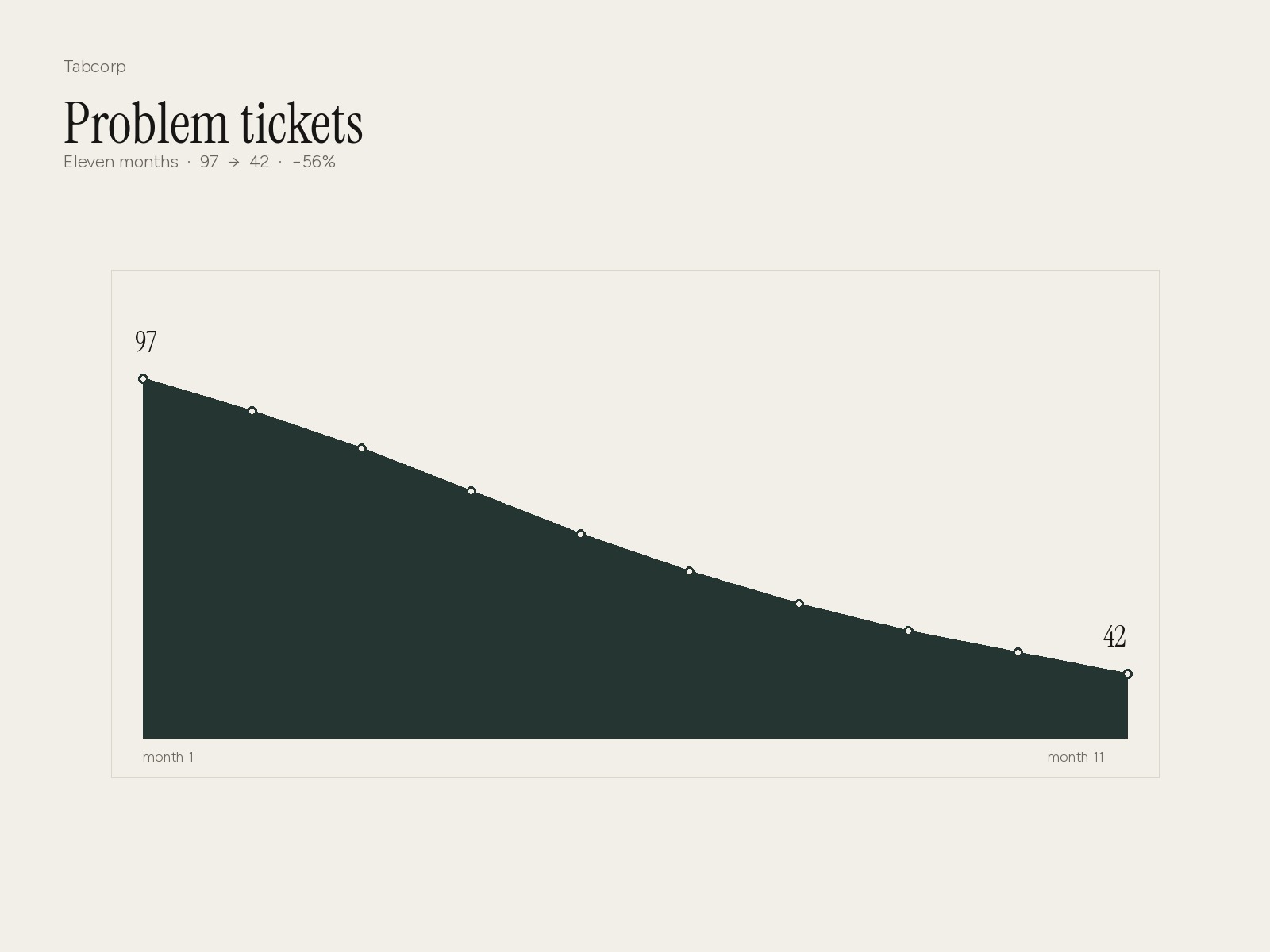
- Reduced ServiceNow problems from 97 to 42 in 11 months. Cut failed production changes 17% as chair of CAB and the Failed Change Board.
- Cleared a backlog of 34 regulatory incident reports, then kept pace at about one every two days, ITGC-ready.
Macquarie Technology

Jun 2021 — Jan 2023
ASX: MAQ. Australian cloud, government cyber and telecom, with data centres in Sydney and Canberra. Not the bank.
Major Incident and Problem Manager · Sydney
Major incident and problem management, including the incident, BC and DR stream for ISO 27001.
- Back online in about 90 minutes after a hardware fault hit ~20% of data-centre traffic, roughly 120 customers.
- Made routine restores consistent. About 30% of majors were routine, but times varied by who was on shift, so the runbooks were rewritten so any shift could follow them.
- ISO 27001 in December 2022 with no findings on major incidents or business continuity. Led that stream.
- 12% off a carrier contract by tracing SLA complaints to coverage gaps. Quarterly award for rotating engineers off a critical bridge after 6 hours.
Nokia

Jun 2018 — May 2021
NYSE: NOK. Global telecom vendor. Onshore service delivery over offshore teams, running network operations for the operator.
Service Delivery Manager — Incident, Problem & Change · Sydney
Dotted-line team of 14. Every P0 was mine. Bushfire bridges with the RFS and the Telco Authority.
- Ran bridges through the 2019–20 Black Summer bushfires with the RFS and Telco Authority, and set the restoration order for critical public sites.
- Built triage so offshore Tier 1 could declare a major without waiting for Sydney. Flew to India and coached 9 incident commanders through a structural change.
- Led 14 people (3 onshore, 11 offshore). Oversaw majors run offshore and took direct command of every P0.
Optus

Dec 2012 — May 2018
Singtel Group. National Australian telco across mobile, fixed, enterprise and media. 24x7 national NOC and command centre.
Incident Controller / Duty Manager, Shift Lead · Sydney
Shift lead for 40 engineers. The 40-minute national tower restore, and the 2014 outage that made the news.
- Restored service in 40 minutes with a 40-engineer shift after a config issue took out ~60% of mobile towers nationally.
- Incident commander for the June 2014 outage that took internet, phone and TV offline across parts of NSW, Victoria and Queensland. Most services back in about 5 hours. Signed off public messaging with corporate comms before VP approval.
- Promoted from incident commander to NOC shift lead within two years. Coached 4 incident commanders. Recognised for back-to-back high-severity bridges of 14+ hours.
NCSI

Where the desk came before the chair.
Service Desk and Incident Controller · Sydney
Service desk, then incident controller.
- Worked the service desk, then moved into the incident controller seat.
How I write in the room
Non-confidential samples — the skeleton I use for a P1 broadcast, a crisis brief, and a PIR. No customer data. Click to open.
P1 comms template
What happened, who is hit, next action, next clock. The sentence executives can take upstairs.
Open templateCrisis / DR brief
One page for the night the event is nationally significant. Situation, actions, decisions, next update.
Open templatePost-incident review
Empty PIR. Impact, timeline, 5 Whys, clocks, comms review, actions with owners.
Open template
How I work
- 01
Restore first. Then tell the truth.
The job on a P1 is service back, then an honest timeline. Executives do not need theatre. They need impact, next action, and when the next update lands.
- 02
The same failure twice is a process problem
Incident command without problem management is just heroics. Trend the majors, train the room, fix the runbook. That is how you cut volume instead of getting better at firefighting.
- 03
Tools are not competence
PagerDuty, Jira, Gemini and Claude are useful when they change MTTD and MTTR. A licence on a slide is not operations. I build the workflow, then I measure it.
- 04
People last longer than the bridge
Fourteen-hour bridges happen. Fatigue rules, engineer swaps after six hours, and a culture that can say the shift is spent — that is how you still have a team tomorrow.
Before the interview
The questions I get asked in the first ten minutes.
- Where do you work from?
- Sydney. Not a relocation story.
- Work rights and clearance?
- Australian citizen. Eligible for security clearance.
- Will you actually take a 2am bridge?
- Yes. I ran 24x7 NOC shifts of ~40 engineers. Fatigue rules exist so the room still has a team tomorrow. I am not interested in a job that pretends incidents happen at 10am.
- What are you looking for?
- Major incident, problem, crisis, command-centre leadership. Global or national P1/P2 ownership. If the role is a ticket queue with no authority on the bridge, it is not the job.
- Permanent or contract?
- Permanent first. Contract if the seat is real — IC / problem / crisis with executive air cover — not a backfill with no mandate.
- Can we see real RCAs and PagerDuty?
- No. Those belong to the employer. The Playbooks section is the skeleton I use, stripped of customer data. In the room I can walk a PIR from memory without opening a ticket.
- Are you only telco?
- No. Telco, data centre, wagering, global SaaS. Same job in different clothes: restore the service, tell the truth, make the next one quieter.
Start a conversation
Send a short note. It lands in my Gmail — [email protected] — and I reply from there.
- [email protected]
- linkedin.com/in/xavierbennet
- Based
- Sydney, Australia